Table of Contents
Why Most Cold Call Voicemails Get Ignored
What Makes a Cold Call Voicemail Actually Work
The Anatomy of a High-Callback Voicemail Script
12 Cold Call Voicemail Script Examples (By Scenario)
Voicemail Timing, Frequency & Cadence Rules
Cold Call Voicemail Mistakes to Avoid
How to Measure and Improve Voicemail Callback Rates
How Cleverly's Cold Calling Service Turns Voicemails Into Booked Meetings
Conclusion
Frequently Asked Questions
Modified On :
September 7, 2026
Key Takeaways
- A voicemail's only job is to earn the callback or the click on your follow-up email. The second you try to pitch the product in it, you've lost the plot.
- Specificity beats polish every time. One real detail about the prospect's company does more work than three perfectly worded value props.
- Write for the eyes, not just the ears. Most people read a transcript of your voicemail before they ever press play, so your script needs to hold up as text.
- A voicemail left in isolation is close to worthless. Pair it with a same-day email and the two touches reinforce each other instead of disappearing separately.
- Treat your script like a testable asset. Change one variable at a time, track callback rate by version, and let the data tell you what's actually working.
Some math nobody likes to say out loud: roughly 80% of cold calls go straight to voicemail. That means your voicemail script isn't a backup plan. It's the primary way most prospects will ever hear from you on a first attempt.
And yet most reps wing it. They ramble, they pitch, they trail off mid-sentence trying to remember the value prop they memorized in onboarding. Then they wonder why voicemail callback rates run in the 4 to 6% range even in mid-market B2B.
There's also a shift happening that most scripts haven't caught up to. Most prospects now read a transcription of your voicemail before they ever listen to it. That changes what "good" sounds like. A message that flows nicely out loud but transcribes into a garbled wall of jargon is going to get deleted before anyone hears your voice.
This guide gives you the anatomy of a voicemail that actually earns a callback, 12 ready-to-use scripts for different scenarios, the timing rules that make them work, and the mistakes quietly killing your numbers.
Whether you're an SDR running 60 dials a day or a founder doing your own outbound, you'll walk away with scripts you can use today.

Why Most Cold Call Voicemails Get Ignored
Before we get into what works, it's worth being honest about why the average voicemail fails. It's rarely one big mistake. It's usually a stack of small ones.
1. They run too long. The second a voicemail passes 30 seconds, most people hit delete before the value ever lands. You had one shot to say something worth acting on, and you spent it clearing your throat.
2. They pitch instead of hook. A voicemail that tries to sell the product leaves nothing open. There's no reason to call back if you already told them everything. The whole point is to create a loop the prospect wants closed, not to close it for them.
3. They sound like everyone else's. Generic scripts read like they were written for "any company in any industry," because they were. Prospects can tell in the first five seconds whether you actually looked into who they are.
4. The number gets rushed. Said once, fast, buried at the very end. Now calling you back requires replaying the message, and most people won't bother.
5. The tone gives it away. Flat delivery, over-rehearsed pacing, or a rep who sounds unsure of themselves. People can hear "cold caller" before you've said your company name.
6. There's no follow-up. A voicemail with no paired email is a message shouted into a void. Nothing reinforces it, so it fades the moment the notification disappears.
The underlying fix for all of this is one mental shift: a voicemail isn't a message, it's a trigger. Its only job is to make the next action (a callback, an email open, a reply) feel obvious.
📞 Get More Callbacks
Cleverly’s done-for-you cold calling helps B2B teams turn 70–100 daily dials into more conversations and qualified meetings.
What Makes a Cold Call Voicemail Actually Work
Once you accept that the voicemail's job is narrow, the rules that follow are pretty simple.
Keep it to 18 to 25 seconds. Long enough to give a real reason to call. Short enough to survive the delete reflex most people have built up.
Sell one thing only. Not the product. The callback, or the email you're sending right after. Pick one ask and build the whole message around it.
Lead with one specific detail. A recent hire, a funding round, an expansion, a tool they just adopted. One researched fact beats three lines of generic value prop, because it proves you're not blasting a list.
Write for transcription. Short sentences. No acronyms. No "synergize your outbound motion" language. If it wouldn't make sense to read as plain text on a phone screen, rewrite it.
Say the number twice, slowly. Once early, once at the end. Nobody should have to replay your voicemail just to write down a phone number.
Leave an open loop. Curiosity gets callbacks. Completeness gets deleted. If you answer every question upfront, there's no reason to pick up the phone.
Reference the email you're sending. If your follow-up email lands the same day, mention its subject line in the voicemail. Now the two touches work as one system instead of two disconnected attempts.
The Anatomy of a High-Callback Voicemail Script
Every script in this guide follows the same five-part structure. Once you internalize this shape, you can write new scripts on the fly without a template in front of you.
1) The Opener (0–3 seconds)
First name, your name, your company. Said calmly, like you're calling a colleague, not working through a list. Nothing kills a voicemail faster than an opener that sounds like a script being read.
Example: "Hey Mark, this is Jamie over at Northline."
2) The Reason for the Call (3–10 seconds)
One specific, researched hook tied to their company, their role, or something that just happened. This is the line that separates a personalized voicemail from a blast, and it's the part most reps skip because it takes actual research.
Example: "Saw you all just closed your Series B, so I'm guessing hiring is about to ramp up fast."
3) The Value Line (10–16 seconds)
One sentence on the outcome you help create, framed around their problem, not your feature list. Skip "we're a leading provider of" entirely. Nobody has ever called back because of a company boilerplate line.
Example: "We help teams like yours fill technical roles about 30% faster without adding headcount to the recruiting team."
4) The Single Ask (16–20 seconds)
One clear next step. Call back, watch for an email, or reply to it. Two asks cancel each other out, so pick one and commit to it.
Example: "I'm sending over a quick note right after this. Just watch for it."
5) The Sign-Off (20–25 seconds)
Name and number, repeated slowly, then stop talking. Don't tack on "thanks so much, have a great day, again this is Jamie" after you've already said everything you needed to. That trailing close is where most voicemails lose their nerve.
Example: "It's Jamie, 555-0148. Again, 555-0148. Talk soon."
🚀 Turn Cold Calls Into Pipeline
With 1M+ cold calls, 53,000+ meetings booked, and $312M+ in pipeline generated, Cleverly helps 10,000+ businesses build predictable outbound growth.
12 Cold Call Voicemail Script Examples (By Scenario)
These aren't one-size-fits-all. Pick the script that matches the situation you're actually in, not the one that sounds the smoothest. Each one comes in under 25 seconds when read at a normal pace, and none of them try to do more than one job.
1) The First-Touch Voicemail
When to use it: Your first attempt on a cold prospect, with one researched detail and no prior relationship.
Script: "Hey Priya, this is Tom over at Basecamp Analytics. Noticed your team's been posting for a couple of RevOps roles, which usually means your reporting stack is getting stretched thin. We help ops teams clean that up without a six-month implementation. Sending you a quick email right after this. It's Tom, 555-0119. Again, 555-0119."
Why it works: The job posting reference proves you actually looked, and the ask stays light.
2) The Trigger Event Voicemail
When to use it: Funding, a new hire, an expansion, a leadership change, or a product launch.
Script: "Hi Dana, it's Marcus from Fieldpoint. Saw the news about your new VP of Sales starting this month. New leaders usually want a quick pipeline win in their first 90 days, and that's exactly where we come in. I'll shoot you a short email today with more on that. This is Marcus, 555-0173. One more time, 555-0173."
Why it works: Trigger events give you built-in relevance that a generic script can never fake.
3) The Referral / Name-Drop Voicemail
When to use it: You have a mutual connection or an internal referrer.
Script: "Hey Alex, this is Sam with Larkspur. Rachel Nguyen on your ops team mentioned you're the right person to talk to about vendor consolidation. I'll drop you a note right after this call with the specifics. It's Sam, 555-0142. Again, that's 555-0142."
Why it works: Name-dropping a known internal contact does more to earn attention than any pitch line could.
4) The Email Follow-Up Voicemail
When to use it: Right before or after sending an email, so the two touches reinforce each other.
Script: "Hi Jordan, it's Casey from Redline. I'm sending an email over in a few minutes with the subject line 'Quick idea for your Q3 pipeline.' Wanted to give you a heads up so it doesn't get lost. Number's 555-0186 if you'd rather just talk it through. Again, 555-0186."
Why it works: Naming the exact subject line turns a weak email into an expected one.
5) The Competitor Insight Voicemail
When to use it: You have a relevant outcome from a peer company, without breaking confidentiality.
Script: "Hey Wes, this is Nina at Groundworkflow. We just helped a company about your size in the logistics space cut their onboarding time nearly in half. Figured it might be relevant given where you all are. I'll send a short email with the details. It's Nina, 555-0161. One more time, 555-0161."
Why it works: A vague but real result creates FOMO without naming names or making a hard pitch.
6) The Question-Only Voicemail
When to use it: Skeptical or senior buyers who tune out anything that sounds like a pitch.
Script: "Hi Elena, it's Ben from Northpath. Quick question. Is your team still handling lead routing manually, or did that move to something automated this year? Give me a call back and let me know, I'm curious how you all landed on that. It's Ben, 555-0134. Again, 555-0134."
Why it works: A genuine, specific question is disarming in a way a pitch never is, and it invites a short, easy reply.
7) The Short and Direct Voicemail
When to use it: Busy executives who reward brevity over everything else.
Script: "Hi Craig, Liam here from Vantage. Reaching out about cutting your customer onboarding time. Call me back at 555-0158 if that's worth ten minutes. Again, 555-0158."
Why it works: No wasted words. Senior buyers often respond better to confidence than to a full explanation.
8) The Second-Attempt Voicemail
When to use it: A follow-up after an unanswered first voicemail. Never repeat the same message verbatim.
Script: "Hey Priya, Tom again from Basecamp Analytics. Following up on my message from last week. One more thing worth mentioning: the RevOps teams we work with usually see clean dashboards live within two weeks, not two months. Email's on its way. It's Tom, 555-0119, one more time 555-0119."
Why it works: Acknowledging the prior touch without guilt-tripping keeps the tone respectful while adding a genuinely new reason to respond.
9) The Wrong-Person Redirect Voicemail
When to use it: You're not fully sure you have the right contact.
Script: "Hi Morgan, this is Ray at Fieldstone. Not totally sure if you're the right person for this, so if I've got the wrong desk, a quick pointer in the right direction would be great. It's about your team's outbound tooling. Number's 555-0127. Again, 555-0127."
Why it works: Low-pressure honesty often gets a helpful reply even from people who aren't buyers.
10) The Case Study / Proof Voicemail
When to use it: You have a specific, concrete result for a similar company.
Script: "Hey Devon, it's Kate from Anchorline. We just helped a healthcare SaaS company book 22 qualified meetings in their first month working with us. Thought that might be relevant given what your team's building. Sending a quick email now. It's Kate, 555-0195. Again, 555-0195."
Why it works: A specific number lands harder than "we help companies grow," and it's short enough to hold attention.
11) The LinkedIn Cross-Channel Voicemail
When to use it: Only after a real LinkedIn touch, so the call feels expected rather than random.
Script: "Hi Sara, this is Owen from Millbrook. Sent you a note on LinkedIn last week about your team's expansion into the Midwest. Wanted to follow up by phone since I know inboxes get buried fast. It's Owen, 555-0112. Again, 555-0112."
Why it works: Referencing a prior touch, even a small one, makes the call feel like a continuation instead of an interruption.
12) The Break-Up Voicemail
When to use it: The final message in a sequence, closing the loop without pressure.
Script: "Hey Mark, Jamie again from Northline. I'll stop reaching out after this one. If hiring speed ever becomes a priority again, my number's 555-0148. No hard feelings either way. Take care."
Why it works: Removing the pressure ironically produces some of the highest reply rates in a sequence, because it doesn't ask for anything.
Voicemail Timing, Frequency & Cadence Rules

A good script wasted on bad timing still won't get a callback. A few rules worth building into your cadence:
1. Call during the windows decision-makers actually answer their own line. Early morning, around lunch, and late afternoon tend to work best, since gatekeepers are less active and people aren't buried in back-to-back meetings.
2. Cap voicemails at two per prospect over a two-week window. Past that, it starts to feel like pestering rather than persistence.
3. Space attempts several days apart, and never repeat the same message. If the second voicemail sounds identical to the first, you've told the prospect you have nothing new to say.
4. Always follow with a same-day email. The voicemail plants your name. The email gives them the easiest possible way to respond, since replying to text takes less effort than dialing a number back.
5. Voicemail is one piece of a bigger sequence. It should sit alongside calls, email, and LinkedIn touches rather than carrying the whole cadence on its own.
6. You don't have to leave a voicemail on every attempt. Dialing without leaving a message is a completely valid tactic, especially on later attempts where a new voicemail wouldn't add anything.
Cold Call Voicemail Mistakes to Avoid
A quick list of the mistakes that quietly tank callback rates, even when the script itself looks fine on paper:
- Rambling past 30 seconds or trying to cram the entire pitch into one message.
- Saying the phone number once, quickly, only at the very end.
- Using jargon or acronyms that garble badly in auto-transcription.
- Reading the script in a flat, robotic tone instead of speaking like a person.
- Leaving the exact same voicemail on repeat attempts with nothing new to say.
- Asking for a meeting directly on a first-touch voicemail, before you've earned that ask.
- Skipping the follow-up email and letting the voicemail's momentum go to waste.
- Writing something so generic it could've been left for any company in any industry.
How to Measure and Improve Voicemail Callback Rates
Treat your voicemail script the way you'd treat any other part of your funnel: as something you test, not something you write once and forget.
✅ Track callback rate on its own. Callbacks divided by voicemails left, broken out by script variant. Without this split, you're guessing at what's working.
✅ Watch the assisted effect too. Some voicemails don't get a direct callback but lift reply rates on the paired email, or lead to an inbound call days later. That's still the voicemail doing its job.
✅ Change one variable at a time. Opener, length, ask, or hook. Test one, hold the rest steady, and you'll actually know what moved the number.
✅ Set realistic benchmarks and expect gradual lift. Callback rates tend to climb across a sequence as familiarity builds, not from any single message.
✅ Record and review voicemails regularly. Tone and pacing issues are nearly impossible to catch in your own head. Hearing yourself back is uncomfortable and useful in equal measure.
✅ Check your data before you rewrite your script. If voicemails are landing on wrong numbers or dead extensions, no amount of script tweaking will fix a data problem wearing a script problem's disguise.
How Cleverly's Cold Calling Service Turns Voicemails Into Booked Meetings
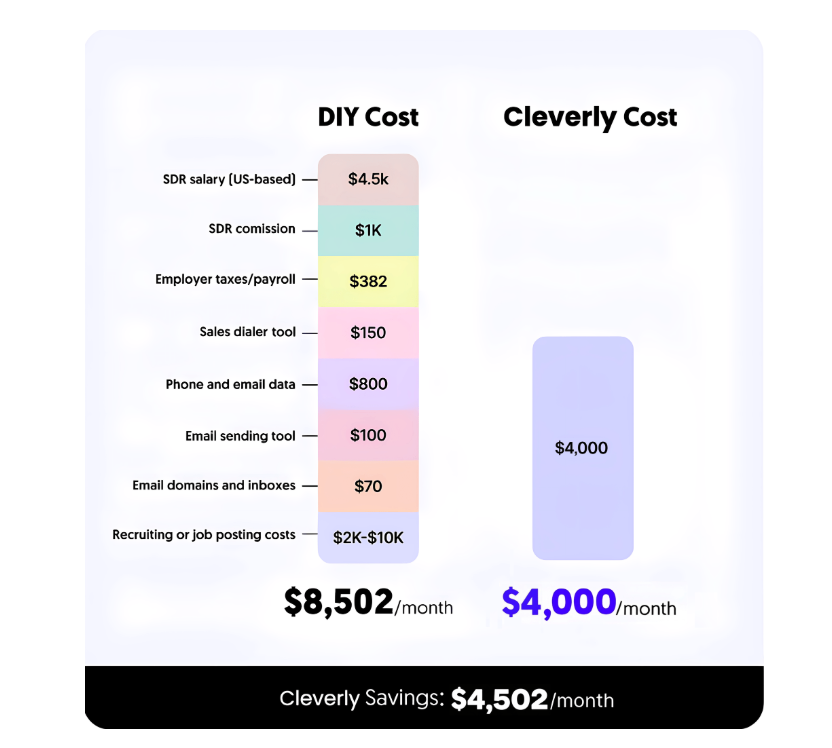
Writing a solid voicemail script is genuinely the easy part. The hard part is doing it at volume, with accurate contact data, day after day, and actually knowing which version is working. That's the part most in-house teams underestimate until they're three months into a cold calling motion that isn't producing.
We built our cold calling service around treating calls and voicemails as one connected system instead of separate tasks. That starts with verified direct-dial data, so voicemails land with the actual decision-maker instead of a switchboard or a number that's been dead for a year.
From there, we place a trained SDR on your account, running scripts and cadences that have been refined across more than 1 million calls, not written once and left untouched.
Every call gets recorded and coached, which is how scripts actually improve over time instead of staying stuck at whatever a rep guessed would work on day one. And the whole system is built around one outcome: booked, qualified appointments, not dial counts or how many voicemails got left.
That focus is part of why our teams have set over 53,000 appointments for clients across nearly every B2B industry.
If your voicemails are going out but the callbacks aren't following, that's usually a data or systems problem, not a willpower problem. Book a strategy call with Cleverly and we'll show you what a fully managed cold calling operation actually looks like.
Conclusion
A cold call voicemail has one job: sell the callback, not the product. Every line in your script should serve that single goal, and the moment it starts doing double duty as a pitch, it stops working.
Structure and brevity will always beat clever copy. Saying your number twice, slowly, matters more than any value prop you could squeeze in. And none of it works in isolation.
A voicemail only earns its keep as part of a system, paired with a same-day email, sequenced with intention, and backed by data that actually reaches the right person.
The teams that treat voicemail as something worth testing, instead of an afterthought before hanging up, are the ones booking meaningfully more meetings from the exact same number of dials.
Frequently Asked Questions
Free Resource
How to Scale a Profitable Cold Call System
Get the complete guide — download it instantly now.

Free Ebook
Download the Free Guide
Enter your details to get instant access.
You're all set! 🎉
Your ebook is downloading now.
Click below if the download didn't start automatically.